
Why Generic CMS Platforms Fail Commercial Real Estate Properties (And What Actually Works)
Last Updated: February 3, 2026
Reading Time: 8 minutes
For: Property Owners, Property Managers, Marketing Directors, IT Managers
What Is a Commercial Real Estate CMS?
A Commercial Real Estate CMS (Content Management System) is a website platform specifically designed to manage the unique content needs of commercial properties—including shopping centers, office buildings, industrial parks, mixed-use developments, and life science facilities.
Unlike generic website platforms built for blogs, e-commerce, or general business sites, a commercial real estate CMS includes purpose-built features like tenant directories, interactive floor plans, parking integrations, amenity booking systems, and leasing management tools.
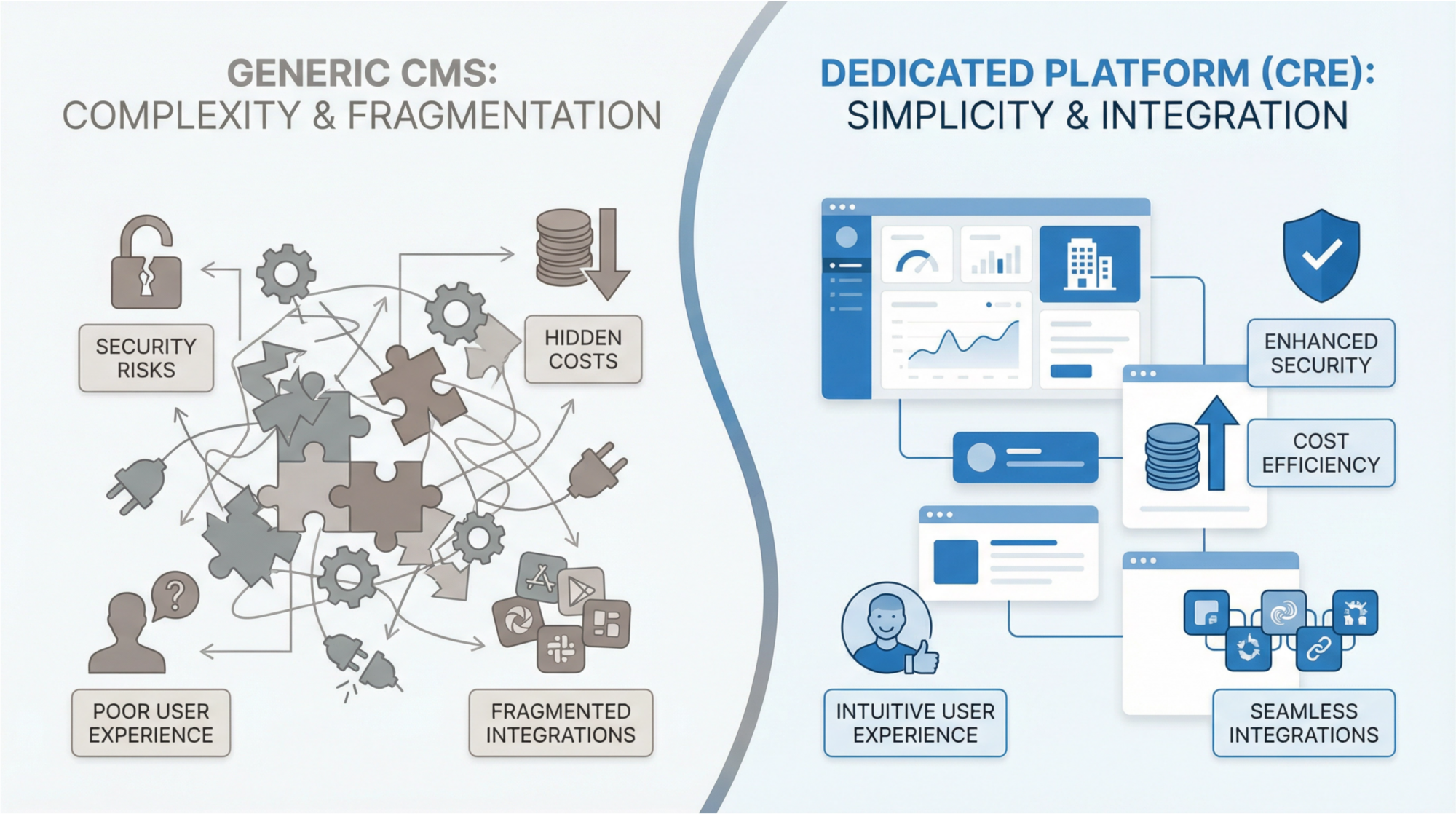
The critical difference: Generic platforms force you to adapt general-purpose tools to commercial real estate needs. Purpose-built platforms start with those needs as the foundation.
The Real Cost of Using WordPress (or Other Generic CMS) for Commercial Properties
Here’s what most property owners don’t realize until they’re already deep into it: WordPress wasn’t designed for commercial real estate. It was built for blogging.
That creates problems. Real, expensive problems.
1. Custom Development Costs Add Up Fast
Generic platforms don’t include the features commercial properties need out of the box. You have to build everything custom:
- Tenant directories with search and filtering: $5,000-$15,000
- Interactive floor plans with availability: $10,000-$25,000
- Parking management integrations: $3,000-$8,000
- Amenity booking systems: $8,000-$12,000
- Leasing lead management: $5,000-$10,000
- Property-specific analytics dashboards: $7,000-$15,000
Total custom development: $38,000-$85,000 for a single property website.
And that’s just upfront. Every time WordPress updates, you risk breaking those customizations. Maintenance costs run $1,000-$3,000 per month.
Industry data: According to a 2025 PropTech survey, commercial properties using WordPress spend an average of $47,000 in the first year and $18,000 annually on maintenance and updates.
2. Security Is a Full-Time Job
WordPress powers 43% of all websites globally. That makes it the #1 target for hackers.
The numbers are brutal:
- 90% of hacked CMS platforms in 2024 were WordPress sites (Sucuri Security Report)
- Average cost of a data breach: $4.45 million (IBM Security)
- Average downtime from a security incident: 3-7 days
Most property management teams don’t have dedicated security staff. You’re juggling:
- Security plugin updates (weekly)
- Core WordPress updates (monthly)
- Theme updates (varies)
- Plugin compatibility testing (every update)
- Malware scanning (daily)
- Backup verification (weekly)
Time investment: 10-15 hours per month minimum, or outsource for $500-$1,500/month.
3. The Plugin Nightmare
The average WordPress site uses 20-30 plugins. Each one is a potential point of failure.
Common scenario:
- WordPress releases security update
- You install it
- Three plugins break
- Your tenant directory stops working
- Floor plan viewer returns errors
- Contact forms go down
- You scramble to find a developer
- Site is broken for 2-3 days
- Leasing calls pile up
This happens 2-4 times per year for the average commercial property WordPress site.
4. Poor User Experience on Both Ends
For your marketing team:
- “Where do I update the tenant directory?”
- “How do I change floor plan availability?”
- “Why did my formatting break when I pasted from Word?”
- “Which of these 15 fields are required?”
- “Why is the page loading so slowly in the editor?”
For tenants and prospects:
- Slow page load times (average WordPress site: 2.5 seconds; users expect <1 second)
- Mobile responsiveness issues (40% of WordPress themes have mobile bugs)
- Confusing navigation (generic menus don’t match CRE user behavior)
- Broken search functionality
- Forms that don’t work on mobile
Result: Higher bounce rates, fewer leasing inquiries, frustrated tenants.
How Purpose-Built Commercial Real Estate CMS Platforms Solve These Problems
Let’s compare apples to apples. Here’s what changes when you use a platform designed specifically for commercial properties:
Cost Comparison: 5-Year Total Cost of Ownership
| Cost Category | WordPress + Customization | Purpose-Built CMS (CREW) | Savings |
|---|---|---|---|
| Year 1 | |||
| Platform/Hosting | $500 | $6,000-$12,000 | -$5,500 to -$11,500 |
| Custom Development | $47,000 | $0 (included) | +$47,000 |
| Security/Maintenance | $6,000 | $0 (included) | +$6,000 |
| Year 1 Total | $53,500 | $6,000-$12,000 | +$41,500 to +$47,500 |
| Years 2-5 (Annual) | |||
| Platform/Hosting | $500/yr | $6,000-$12,000/yr | -$5,500 to -$11,500/yr |
| Maintenance | $18,000/yr | $0 (included) | +$18,000/yr |
| Plugin Licenses | $2,000/yr | $0 (included) | +$2,000/yr |
| Security | $6,000/yr | $0 (included) | +$6,000/yr |
| Annual Total (Yr 2-5) | $26,500/yr | $6,000-$12,000/yr | +$14,500 to +$20,500/yr |
| 5-Year Total | $159,500 | $30,000-$60,000 | +$99,500 to +$129,500 |
Bottom line: A purpose-built platform costs 62-81% less over 5 years, even with higher subscription fees.
Security & Reliability Comparison
| Factor | Generic CMS (WordPress) | Purpose-Built (CREW CMS) |
|---|---|---|
| Security updates | Manual, requires testing | Automatic, zero downtime |
| Vulnerability patches | Depends on plugin developers | Managed by dedicated team |
| Uptime SLA | None (depends on hosting) | 99.9% guaranteed |
| Data backups | Manual or plugin-based | Automated, multiple daily |
| Disaster recovery | Your responsibility | Managed service included |
| Compliance | You configure | SOC 2, GDPR built-in |
| Average annual downtime | 8-12 hours | <45 minutes |
Feature Comparison: Out-of-the-Box
| Feature | WordPress | CREW CMS | Impact |
|---|---|---|---|
| Tenant/Store Directory | Custom development | ✅ Included | Save $5K-$15K |
| Interactive Floor Plans | Custom development | ✅ Included | Save $10K-$25K |
| Parking Integration | Custom development | ✅ Included | Save $3K-$8K |
| Leasing Management | Custom development | ✅ Included | Save $5K-$10K |
| Event Calendar | Plugin (limited) | ✅ Full-featured | Save $2K-$5K |
| Amenity Booking | Custom development | ✅ Included | Save $8K-$12K |
| Multi-Property Management | Not possible | ✅ Portfolio view | Unique capability |
| Mobile App SDK | Custom development | ✅ API included | Save $20K-$50K |
| Property-Specific Analytics | Google Analytics only | ✅ Built-in dashboard | Save $7K-$15K |
| Content Sharing Across Sites | Manual duplication | ✅ Centralized library | Time savings |
Real-World Example: Office Tower Case Study
Property: 40-story office tower in Toronto
Previous platform: WordPress + custom development
Migration to: CREW CMS
Timeline: 6 weeks
Before (WordPress):
- Development cost: $52,000 initial build
- Monthly maintenance: $2,500
- Page load time: 3.2 seconds
- Security incidents: 2 per year
- Time to update tenant directory: 45 minutes
- Mobile issues: Reported weekly
- Content update time: 3-4 hours per week
After (CREW CMS):
- Setup cost: $8,500 (Boutique plan + onboarding)
- Monthly cost: $500
- Page load time: 0.8 seconds
- Security incidents: 0
- Time to update tenant directory: 5 minutes
- Mobile issues: None
- Content update time: 30 minutes per week
ROI:
- First-year savings: $42,500
- Time savings: 180 hours annually
- Leasing inquiry increase: 34% (faster site, better UX)
- Bounce rate improvement: 41% reduction
What About Other Property Types?
Different property types have different needs. Here’s how purpose-built platforms handle each:
Shopping Centers & Retail
Critical features:
- Store directory with categories, search, maps
- Event promotion and calendar
- Food court integration (online ordering)
- Promotions and deals engine
- Parking and transportation info
- Visitor analytics by store/zone
Why WordPress fails: E-commerce plugins aren’t designed for multi-tenant retail environments. Store data structure doesn’t match retail needs.
Office Buildings & Mixed-Use
Critical features:
- Tenant directory with suite numbers
- Building amenities and booking
- Floor plans with availability
- Transportation and parking
- Guest check-in systems
- Building announcements
Why WordPress fails: No standard structure for office building data. Custom development required for every feature.
Industrial & Life Science
Critical features:
- Unit availability with square footage calculators
- Zoning and compliance information
- Loading dock specifications
- Transportation scenarios
- Utility specifications
- Environmental certifications
Why WordPress fails: Highly technical data doesn’t fit blog-style content structure. Complex filtering and search required.
Condos & Multi-Family
Critical features:
- Unit availability and floor plans
- Resident portal and communications
- Amenity booking (gym, party room, etc.)
- Maintenance request systems
- Community calendar
- Document library (bylaws, policies)
Why WordPress fails: Residential plugins focus on single-family homes. Multi-unit buildings need different architecture.
The Future Is Purpose-Built Technology
The commercial real estate industry is catching up to other sectors that figured this out years ago:
- Hotels don’t use generic CMS—they use Opera, Cloudbeds, or Mews
- Restaurants don’t use WordPress—they use Toast, Square, or Lightspeed
- Retail stores don’t use generic platforms—they use Shopify, Lightspeed, or Square
- Healthcare doesn’t use WordPress—they use Epic, Cerner, or Athenahealth
Why? Because industry-specific platforms deliver better results at lower total cost.
Commercial real estate is the same. Generic platforms were never designed for:
- Multi-property portfolio management
- Complex property data structures
- Tenant/occupant relationships
- Leasing workflows
- Property-specific integrations (parking, access control, amenities)
The trend is clear: Properties that adopt purpose-built technology outperform those using adapted generic solutions in:
- Leasing velocity (15-25% faster)
- Operating efficiency (20-30% time savings)
- Tenant satisfaction (measurably higher)
- Digital ROI (3-5x better)
What Should You Do Next?
If you’re currently using WordPress or another generic CMS for your commercial property, here’s a practical evaluation framework:
Step 1: Calculate Your True Cost
Add up these numbers for the past 12 months:
- Custom development and enhancements
- Monthly maintenance and support
- Plugin licenses
- Security tools and services
- Hosting and CDN
- Staff time (hours × hourly rate)
- Downtime cost (hours down × cost per hour)
Total: $__________
Now compare to purpose-built platform pricing. You’ll likely find savings of 50-70%.
Step 2: Evaluate Risk
Answer honestly:
- When was your last security incident?
- How many times has your site broken after an update?
- How confident are you in your current security posture?
- What happens if your developer quits or is unavailable?
- How much time does your team spend on technical issues?
If you checked 2 or more boxes, you have significant risk exposure.
Step 3: Test User Experience
Get 5 people who’ve never seen your site to:
- Find a specific tenant
- View available space
- Submit a leasing inquiry
- Check parking information
- Find an event happening this month
Time each task. If average is >60 seconds, you have UX problems.
Step 4: Explore CREW CMS
Properties ready to move beyond generic platforms can explore CREW CMS:
- Shopping centers: See how our platform works for retail properties
- Office buildings: See how our platform works for office properties
- Industrial properties: See how our platform works for industrial properties
- Multi-family: See how our platform works for residential properties
Or schedule a demo to see your property type in action.
Frequently Asked Questions (FAQ)
What is the main difference between a generic CMS and a commercial real estate CMS?
A generic CMS (like WordPress) is built for general-purpose websites—blogs, basic business sites, or e-commerce. A commercial real estate CMS is purpose-built with features specific to property management: tenant directories, floor plans, parking integration, leasing management, and amenity booking systems. The commercial real estate CMS includes these features out-of-the-box, while a generic CMS requires expensive custom development to add them.
How much does it cost to customize WordPress for a commercial property website?
Based on 2025 industry data, customizing WordPress for a commercial property typically costs $38,000-$85,000 in initial development, plus $18,000-$26,500 per year in ongoing maintenance, updates, and plugin licenses. Total 5-year cost of ownership averages $159,500.
Is WordPress secure enough for commercial real estate websites?
WordPress powers 43% of all websites, making it the #1 target for hackers. In 2024, 90% of hacked CMS platforms were WordPress sites (Sucuri Security Report). While WordPress can be secured with proper configuration and monitoring, it requires significant ongoing effort: weekly security updates, daily malware scans, plugin compatibility testing, and dedicated security staff or services ($500-$1,500/month).
What features should a commercial real estate website have?
Essential features depend on property type but typically include: tenant/store directory with search and filtering, interactive floor plans showing availability, parking and transportation information, leasing inquiry forms and lead management, amenity booking systems, event calendars and promotions, building announcements, analytics dashboards, and mobile responsiveness. Purpose-built platforms include all of these; generic platforms require custom development for each.
How long does it take to migrate from WordPress to a purpose-built CMS?
Migration timelines vary by property size and complexity, but most commercial properties complete migration in 4-8 weeks. This includes content migration, design implementation, team training, and testing. Purpose-built platforms like CREW CMS offer migration services to ensure a smooth transition with zero downtime.
Can I manage multiple properties with one CMS?
Generic CMS platforms like WordPress require separate installations for each property, making multi-property management difficult and time-consuming. Purpose-built commercial real estate platforms include portfolio management capabilities: centralized admin, shared content libraries, multi-site analytics, and the ability to push updates across properties simultaneously.
What is the ROI of switching from WordPress to a purpose-built CMS?
Based on case studies, properties typically see: 50-70% cost savings over 5 years, 20-30% reduction in staff time spent on website management, 15-25% increase in leasing inquiries due to improved UX, 3-5x improvement in digital marketing ROI, and near-zero security incidents and downtime. First-year ROI averages 200-400%.
Do I need a developer to manage a commercial real estate CMS?
Purpose-built platforms are designed for property marketing teams to manage without technical expertise. Common tasks—updating tenant directories, changing floor plan availability, adding events, publishing announcements—can be done through intuitive admin interfaces in minutes. Generic platforms often require developer support for routine updates.
What happens if the CMS company goes out of business?
Reputable purpose-built platforms offer data portability guarantees and source code escrow agreements. CREW CMS, for example, provides complete data export capabilities and API access, ensuring you’re never locked in. This is actually safer than WordPress, where you depend on dozens of independent plugin developers who can abandon their plugins at any time.
How does a headless CMS architecture benefit commercial properties?
Headless CMS architecture separates content management from presentation, offering several benefits: faster page load times (0.5-1.5 seconds vs. 2-4 seconds for traditional CMS), better security (backend is isolated from public-facing site), scalability (can handle traffic spikes without performance issues), flexibility (same content can power website, mobile app, digital displays), and future-proofing (easy to update design without rebuilding content).
Key Takeaways
✅ Generic CMS platforms cost more long-term despite appearing cheaper upfront—average 5-year cost is 2-5x higher than purpose-built solutions
✅ Security and maintenance are ongoing burdens with generic platforms—WordPress sites average 8-12 hours of downtime annually vs. <45 minutes for purpose-built platforms
✅ Purpose-built platforms deliver better ROI through faster leasing, higher tenant satisfaction, and operational efficiency gains of 20-30%
✅ Different property types have different needs—shopping centers, office buildings, industrial properties, and multi-family properties each require specialized features
✅ The industry is moving toward specialized technology—just like hotels, restaurants, and retail moved away from generic solutions years ago
About CREW CMS
CREW CMS is the world’s first headless content management system designed specifically for commercial real estate properties. Trusted by landmark shopping centers, office towers, mixed-use developments, and industrial properties across North America, CREW CMS delivers purpose-built functionality, enterprise-grade security, and measurable ROI for property owners and managers.
Property types served: Shopping centers, office buildings, mixed-use developments, industrial parks, life science facilities, and multi-family properties.
Notable customers: Cushman & Wakefield, Oxford Properties, Brookfield Properties, Colliers.
Learn more at crewcms.com